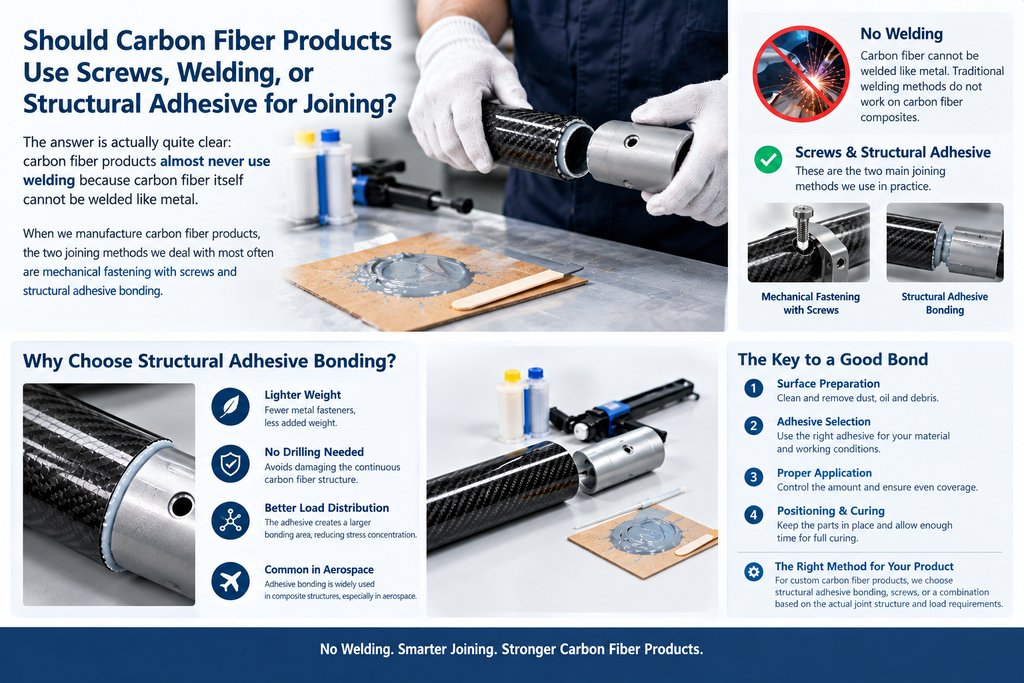

Should Carbon Fiber Products Use Screws, Welding, or Structural Adhesive for Joining?
First, the answer is actually quite clear: carbon fiber products almost never use welding because carbon fiber itself cannot be welded like metal.
When we manufacture carbon fiber products, the two joining methods we deal with most often are mechanical fastening with screws and structural adhesive bonding. If the product structure allows it, we often prefer structural adhesive bonding instead of drilling holes into the carbon fiber tube.
The reason is simple. Drilling directly into a carbon fiber tube can damage the continuous fiber structure. Once holes are made, some of the fibers are cut, and stress can become concentrated around the drilled area when the part is loaded.
With structural adhesive bonding, there is no need to drill through the carbon fiber. The adhesive creates a bonding layer between the carbon fiber component and the connecting part, allowing the load to be transferred over a larger bonding area. It can also reduce the need for additional metal fasteners, helping keep the overall assembly lightweight.
This is one reason adhesive bonding is widely used for composite assembly, including aerospace composite structures.
Of course, structural adhesive bonding is not simply a matter of applying some glue and putting the parts together. Surface preparation, adhesive selection, adhesive thickness, application, positioning, and curing all affect the final joint.
For custom carbon fiber products, we normally choose between structural adhesive bonding, screws, or a combination of both according to the actual joint structure and load requirements.